The SEMA Code of Practice and the SARI Inspector Who Applies It
This page explains the standard itself: what the SEMA Code of Practice requires of an inspection, what SARI accreditation means for the person carrying it out, and how measured tolerances translate into red, amber and green classifications. For inspection availability, coverage and booking, see our main racking inspection page.
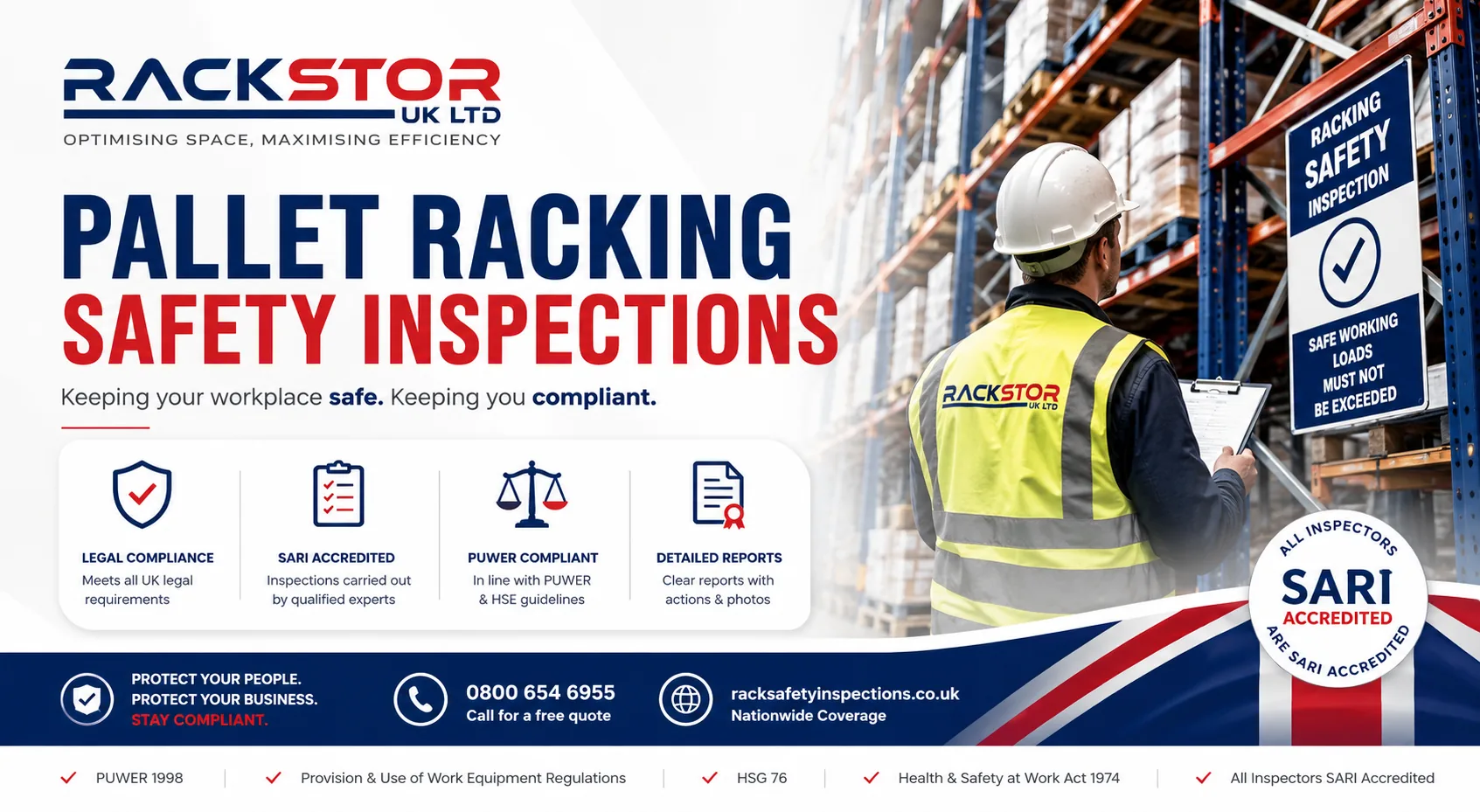
- SARI Accredited Inspectors
- SEMA Code of Practice
- Red / Amber / Green Classification
- Written Report Within 48 Hours
- PUWER 1998 & HSG76 Compliant
- Nationwide UK Coverage
Ready to book your inspection?
Fixed-price quotes, usually the same day — nationwide coverage.
What a SEMA Racking Inspection Means
A SEMA racking inspection is a formal expert inspection of all pallet racking on site, carried out to the SEMA Code of Practice by a SARI accredited inspector. It is the inspection HSE expects under HSG76 and the only inspection recognised across the UK insurance and warehousing industry as fully compliant. The inspector assesses every upright, beam, baseplate, bracing and load notice, photographs defects, and issues a formal written report.
Legal Basis — PUWER 1998 and HSG76
Pallet racking is work equipment under the Provision and Use of Work Equipment Regulations 1998 (PUWER). Regulation 6 requires inspection at suitable intervals by a competent person. HSE guidance HSG76 ("Warehousing and storage: A guide to health and safety") and the SEMA Code of Practice specify that an expert inspection by a technically competent person — a SARI accredited inspector — must be carried out at least once every 12 months. Failure to comply exposes employers to enforcement action and significantly increases liability following an incident.
SARI Accreditation Explained
SARI (SEMA-Aligned Rack Inspector) is the only nationally recognised accreditation scheme for racking inspectors in the UK. To qualify, an inspector must demonstrate substantial industry experience, pass the SEMA technical examination and maintain ongoing CPD. Only a SARI accredited inspector can issue a SEMA-aligned racking inspection report. Insurers, landlords and HSE inspectors will all look first for the inspector's SARI number on the report.
Every Rackstor UK Ltd inspection is carried out by Mr Gordon Thelwell, SARI No. 0100, a CIEH Professional Trainer with nearly 40 years in the storage equipment industry. His SARI number and signature appear on every report we issue, so the competence behind the inspection is verifiable by your insurer or an HSE inspector.
What Happens During a SEMA Racking Inspection
A SEMA racking inspection follows a structured, bay-by-bay process. Our SARI accredited inspector attends site, completes a short induction, then systematically examines every run of racking:
- Upright frames — bends, buckles, splits, corrosion and impact damage
- Beams and safety clips — engagement, deflection and damage
- Baseplates and floor fixings — lift, cracking and looseness
- Bracing and connections — damage, missing fixings, loose bolts
- Load notices — presence, legibility, accuracy against installed configuration
- Pallet condition and overhang where relevant to racking safety
Every defect is photographed and classified using the SEMA red / amber / green traffic-light system. The inspector records location, component, defect type and recommended action, and issues a formal written report within 48 hours of the visit.
Red, Amber, Green Classification
Danger of collapse. Offload and isolate immediately; replace damaged component.
Damage exceeds SEMA limits. Repair within four weeks; reclassified RED if not actioned.
Damage within SEMA limits. Continue use but monitor at weekly visual checks.
The classification is not a matter of judgement. BS EN 15635 (the standard the SEMA Code of Practice applies) sets precise numerical damage tolerances, and every measurement taken on site is compared against them:
| Component | BS EN 15635 tolerance |
|---|---|
| Upright frontal (cross-aisle) deflection | Max 3mm over a 1m gauge |
| Upright lateral (down-aisle) deflection | Max 5mm over a 1m gauge |
| Bracing member deflection | Max 10mm |
| Beam deflection under load | Max Span / 200 |
| Beam residual deformation (unloaded) | Max Span / 1000 |
An upright bent 3mm over a 1m gauge in the cross-aisle direction is at the limit; beyond it, the component is classified amber and must be repaired within four weeks. Because the tolerances are numerical, the report you receive states measured figures — not opinions — which is exactly what insurers and HSE inspectors expect to see.
Inspection Frequency Requirements
SEMA and HSG76 set out a three-tier inspection regime: immediate reporting of any damage by every warehouse operative; weekly visual inspections by a nominated Person Responsible for Racking Safety (PRRS); and a formal expert inspection at least every 12 months by a SARI accredited inspector. High-traffic sites, MHE-intensive operations or sites with recent impact damage may require more frequent expert inspections.
What You Receive
Within 48 hours of the visit you receive a formal written SEMA-aligned inspection report. The report opens with the site details, the racking types inspected and the inspector's SARI number and signature — the evidence your insurer or an HSE inspector will ask for first. The body of the report is an itemised schedule of every defect found: each entry records the exact location (run, bay and component), a photograph, the measured damage against the BS EN 15635 tolerances, and its red, amber or green classification with the required action and timescale.
The report closes with a prioritised list of repair recommendations — red items first — so you can hand it directly to a repair contractor, and a compliance certificate confirming the inspection was carried out to HSG76, the SEMA Code of Practice and PUWER 1998. In short:
- Formal written SEMA-aligned inspection report within 48 hours
- Inspector SARI number and signature for insurance and HSE evidence
- Itemised schedule of every defect with location, photograph, measured tolerance and classification
- Prioritised list of repair recommendations
- Compliance certificate confirming HSG76 / SEMA / PUWER compliance
- Telephone support throughout the year for any racking safety question
What Our Customers Say
“I have formed a very close partnership with Rackstor having worked with them on many projects over several years. Reliable, knowledgeable and extremely professional. They have never let me down.”
“Really professional company from start to finish. Went above and beyond to accommodate our ever changing requirements. Left the site clean and tidy, and worked really conscientiously. Would highly recommend.”
“Professional, fast and expert services from the get-go to sign off. Highly recommended.”
Read more on our customer reviews page.
SEMA Racking Inspection FAQs
Book a SEMA-Aligned Racking Inspection
Tell us your site postcode, approximate number of racking bays and racking type. We will come back with a fixed price — usually the same day.