Pallet Racking Inspection FAQs
Everything UK warehouse operators ask us about SEMA-aligned racking inspections.
Is a racking inspection a legal requirement?+
Yes — under the Health and Safety at Work Act 1974 and PUWER 1998 (Provision and Use of Work Equipment Regulations), UK employers have a legal duty to ensure work equipment, including pallet racking, is maintained in a safe condition and inspected at suitable intervals by a competent person. HSG76 (HSE's guidance on warehousing and storage) and BS EN 15635 set out the recognised standard for how this should be done: an expert inspection at least once every 12 months, alongside routine visual checks. So while HSG76 itself is guidance rather than law, the underlying duty to inspect racking IS a genuine legal requirement under PUWER 1998.
Read more: HSE racking inspection & legal duties →
How often should pallet racking be inspected?+
HSE guidance HSG76 and EN 15635 recommend an expert inspection by a competent person (such as a SEMA-aligned inspector) at least once every 12 months, plus weekly visual checks by a trained PRRS (Person Responsible for Racking Safety).
Is Rackstor SEMA approved?+
Rackstor UK Ltd follows SEMA (Storage Equipment Manufacturers' Association) guidelines and the SEMA Code of Practice on every inspection — a status some customers refer to informally as 'SEMA approved'. Strictly, SEMA does not certify companies as 'approved'; individual inspectors hold personal SARI (SEMA-Aligned Rack Inspector) accreditation instead. Our lead inspector, Mr G. Thelwell, holds genuine SARI accreditation (SARI No. 0100), which you can verify independently at sari.sema.org.uk.
Read more: 'SEMA approved' explained →
Are your inspectors SEMA-aligned?+
Yes — all Rackstor UK Ltd inspections are carried out by SEMA-aligned and SARI accredited inspectors, fully qualified to issue compliant risk-rated reports.
Do you cover the whole of the UK?+
Yes. Nationwide UK coverage including England, Scotland, Wales, Northern Ireland, Isle of Man, Jersey and Guernsey. Multi-site rates available.
How fast can you provide a quotation?+
Same-day quotations as standard. Reports are typically issued within 48 hours of the on-site inspection.
What is a pallet racking safety inspection?+
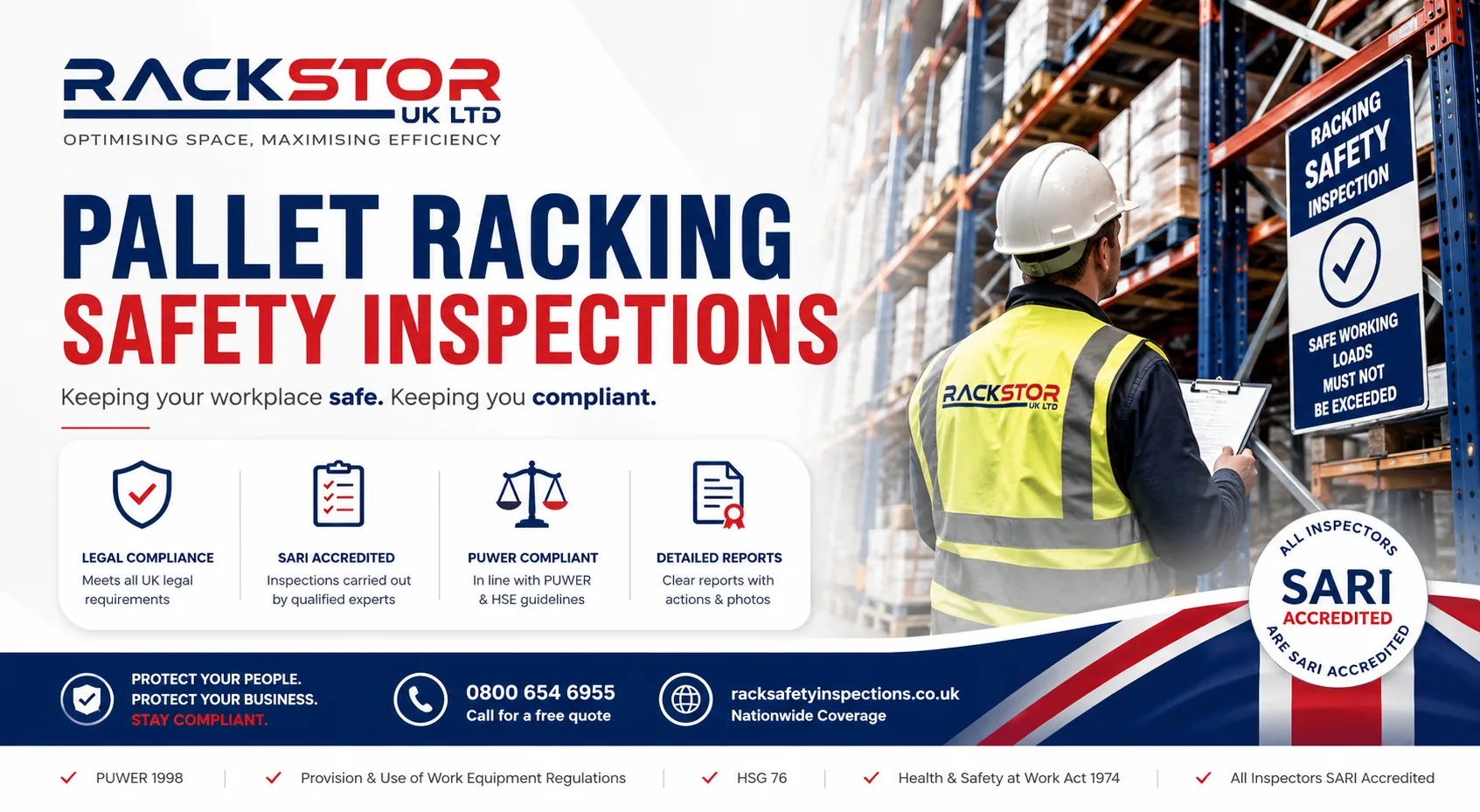
A pallet racking safety inspection is a formal expert examination of your racking installation by a SEMA-aligned, SARI accredited inspector. It checks uprights, beams, baseplates, bracing and load notices for damage or non-compliance, and classifies every defect red, amber or green in line with HSG76 and BS EN 15635. Many warehouse operators also refer to this as a warehouse racking inspection.
What standards do your reports comply with?+
HSE HSG76, BS EN 15635:2008, PUWER 1998 and the Health & Safety at Work Act 1974 — with red/amber/green risk classification of every fault.
How do I know your inspector is genuinely SARI accredited?+
You don't have to take our word for it. SEMA operates a free public verification tool at sari.sema.org.uk where you can check any inspector's SARI status directly by name and ID number — including ours, SARI No. 0100.
Is a pallet rack inspection the same as a pallet racking inspection?+
Yes — 'pallet rack inspection' and 'pallet racking inspection' describe the same service: an expert examination of your pallet racking installation by a SEMA-aligned, SARI accredited inspector, carried out to HSG76, BS EN 15635 and PUWER 1998. 'Pallet rack inspection' is the more common phrasing in North America; in the UK the industry usually says 'pallet racking inspection'. Rackstor UK Ltd provides both under a single fixed-price quotation.
What does your pallet rack inspection service include?+
Our pallet rack inspection service is a bay-by-bay expert examination of every upright, beam, base plate, brace and load notice by a SARI accredited inspector. Every defect is photographed, located and classified red, amber or green under the SEMA / EN 15635 traffic-light system, with a written PDF report issued within 48 hours of the on-site visit and a compliance certificate for HSG76 and PUWER 1998.
What is a SARI racking inspection?+
A SARI racking inspection is a pallet racking inspection carried out by an inspector who holds current SARI (SEMA-Aligned Rack Inspector) accreditation, working to the SEMA Code of Practice. The defining feature of a SARI racking inspection is that the named individual on the report is on the SEMA SARI register — their personal SARI number appears on the report and can be verified independently at sari.sema.org.uk. Rackstor's lead inspector Mr G. Thelwell holds SARI No. 0100.
Read more: our SARI accredited inspector →
What is a warehouse racking inspection?+
A warehouse racking inspection is the same expert service as a pallet racking inspection: a formal examination of your warehouse racking system by a SEMA-aligned, SARI accredited inspector. It checks uprights, beams, braces, baseplates and load notices for damage, wear or non-compliance, and classifies every defect red, amber or green under HSG76 and BS EN 15635.