Annual SEMA Expert Inspection
The annual expert racking inspection expected under HSE guidance HSG76, carried out by a SEMA-aligned, SARI accredited inspector, with every defect measured against BS EN 15635, located to a bay reference and risk-rated red, amber or green.
Included as standard
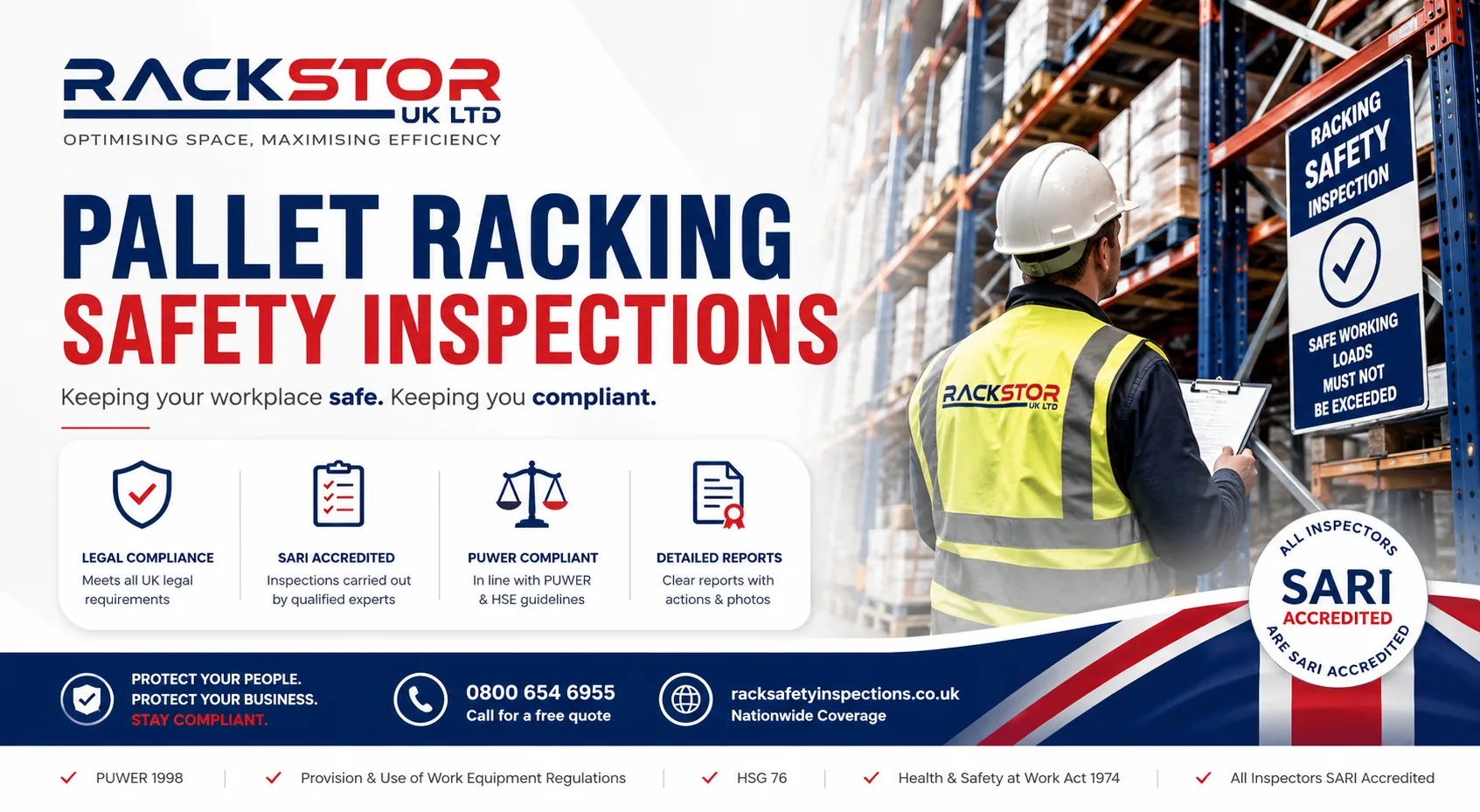
- Full installation inspected, not sampled
- SARI accredited, SEMA-aligned inspector
- Damage measured against BS EN 15635
- Red / amber / green risk classification
- Bay-referenced findings with photographs
- Written report issued within 48 hours
Why the annual expert inspection exists
Pallet racking is work equipment. PUWER 1998 regulation 5 requires it to be maintained in an efficient state and in good repair, and regulation 6 requires inspection where safety depends on installation conditions — at suitable intervals, and after any exceptional circumstances liable to jeopardise safety. PUWER does not name a period; HSE guidance HSG76 does, setting the expectation that a technically competent person inspects racking at intervals not exceeding 12 months, alongside regular visual inspections by trained site staff.
The expert inspection is the independent layer. A weekly walk-round by your own team catches new damage quickly but normalises damage that has been there a while. An inspector from outside the operation arrives without that history, measures against the tolerances in BS EN 15635 rather than against what the site has grown used to, and assesses the installation as a system rather than as a set of components.
The output is the document you will be asked for by an insurer, a client audit or an HSE inspector — see the wider legal context on our PUWER racking inspection and HSE racking inspection pages.
What the inspection covers
Uprights are checked over their full height and on both front and rear faces. Out-of-straightness is measured against a straight edge in both planes, with a sharp kink treated more seriously than a smooth bow of similar amplitude because it concentrates the loss of section. Torn or distorted connector holes, sheared or missing bolts, splices and corrosion causing section loss are all recorded.
Beams are checked for permanent deflection remaining after load is removed, damage or distortion at the end connectors, connector welds, and missing or dislodged safety clips. Bracing is checked for damaged, detached or missing members — including members removed for access and never reinstated. Baseplates and floor fixings are checked for loose, missing or sheared anchors, uneven packing, plates lifting and cracking in the slab.
The inspector then assesses the installation itself: beam pitch and configuration against design intent, aisle widths against the MHE actually in use, frame protection and end-of-run barriers at pinch points, whether load notices match the configuration in front of them, and whether the site's weekly inspection records reflect what is visible on the racking today.
How findings are classified and reported
Every defect is classified against BS EN 15635 using the traffic-light system. Green risk means damage within tolerance — recorded and monitored. Amber risk means the component is outside tolerance but safe short term, and must be replaced within a defined period, commonly four weeks. Red risk means the component cannot be relied on to carry load: the bay is offloaded immediately and isolated until repaired. There is a full explanation in red, amber and green damage explained.
Red-risk findings are raised with you on site before the inspector leaves, so a compromised bay can be offloaded the same day rather than waiting for the paperwork.
The written report follows within 48 hours. Each finding carries a bay or run reference, the component affected, the observation or measurement, its classification, a photograph and a recommended action, with items prioritised so the order of work is obvious. Installation-level observations on configuration, load notices, protection and the interim regime are included, and the report is written to be understood by someone who was not on site.
How it runs on the day
You do not need to empty the racking. Inspections are carried out on loaded, working installations, because that is the condition the racking operates in, and the inspector works around live picking and replenishment. Most single-site installations are completed within a working day depending on bay count, beam levels, racking type and access.
Preparation is minimal. It helps to have your existing load notices, any manufacturer documentation, your weekly PRRS records and a note of recent impacts to hand, and to have bay references physically marked on the racking so findings can be located consistently afterwards. There is a step-by-step walkthrough in what happens during a SEMA racking inspection.
Repairs are deliberately not part of the inspection and are quoted separately, so findings are never influenced by the value of the remedial work that follows. Where work is needed, see damage repair and replacement guidance.
Making the report worth more than a certificate
Deal with red items immediately, give every amber item an owner and a completion date, sign each off against the report line when done, and carry green items onto your weekly inspection route so they are walked past deliberately rather than by chance. That closed-out record — not the report alone — is what evidences compliance with PUWER regulation 6.
Watch for repeat locations. Where the same bays appear year after year, the cause is usually traffic layout, aisle width or pick-face position rather than the steel.
If your weekly regime has lapsed or your nominated person has moved on, the inspection is the natural point to put it back in place through weekly PRRS training.
Annual SEMA Expert Inspection FAQs
Is an annual racking inspection a legal requirement?
No regulation names a twelve-month interval, but PUWER 1998 regulation 6 requires inspection at suitable intervals and after exceptional circumstances, and HSE guidance HSG76 sets the expectation of an expert inspection at intervals not exceeding 12 months. That is the benchmark used in practice by HSE, insurers and auditors.
Who carries out the inspection?
A SEMA-aligned, SARI accredited inspector — a technically competent person independent of the day-to-day operation of your site, working to SEMA codes of practice and BS EN 15635 tolerances.
Do we have to empty the racking?
No. The installation is inspected loaded and in use. Only bays classified red risk need to be offloaded, and that is the immediate action arising from the inspection rather than preparation for it.
How long does it take and when do we get the report?
Most single sites are completed within one working day, with the written risk-rated report issued within 48 hours. Any red-risk finding is raised with you on site before the inspector leaves.
Does this replace our weekly checks?
No. BS EN 15635 expects both: regular visual inspections by a trained PRRS, normally weekly, and a periodic expert inspection at least annually. The expert inspection also reviews whether your weekly regime is functioning.
How much does it cost?
Cost is driven by bay count, beam levels, racking type, site location and access, so we quote against the specific site rather than publishing a rate. Tell us your postcode and approximate bay count and we will provide a fixed written quotation — see our inspection cost page.